
corporate · stories · events
The corporate retreat that became a yearly tradition
How one company's annual leadership offsite migrated from a desert resort to a houseboat — and why it kept coming back. An archetypal account.
This is another archetypal account drawn from the patterns we've seen with corporate clients who've used houseboats for leadership offsites. Names and identifying details are composites; the experiences are real.
The setup
A mid-sized UAE-based professional services firm. Twelve-person leadership team. The annual two-day offsite had been at desert resorts for years. Comfortable, predictable, increasingly unmemorable.
The CEO's frustration: every year started the same way, ended the same way, produced the same kind of mid-energy commitment. The offsite had become a calendar item to be survived rather than a working session.
A new HR director suggested trying something different. Specifically: a weekend on a chartered houseboat instead of a hotel.
The CEO was skeptical. Twelve adults on a boat felt logistically uncertain. He approved it as an experiment with the option to revert next year.
The first year
The 18-meter boat was hired through a managed-charter operator. The team boarded Friday afternoon, cruised to a sheltered anchorage off Saadiyat, anchored for the weekend, returned Sunday evening.
Friday evening: an icebreaker dinner on the bridge deck. Casual; everyone in shorts; hard to maintain the formal hierarchy in that setting.
Saturday morning: leadership working session in the main salon. Coffee on the deck. The discussion was different from previous years — more candid, more substantive. The HR director attributed it later to the setting; you can't easily walk out of a working session on a boat.
Saturday afternoon: optional swim, optional reading, semi-mandatory conversation in smaller groups. The CEO had one-on-ones with three team members in the corners of the deck.
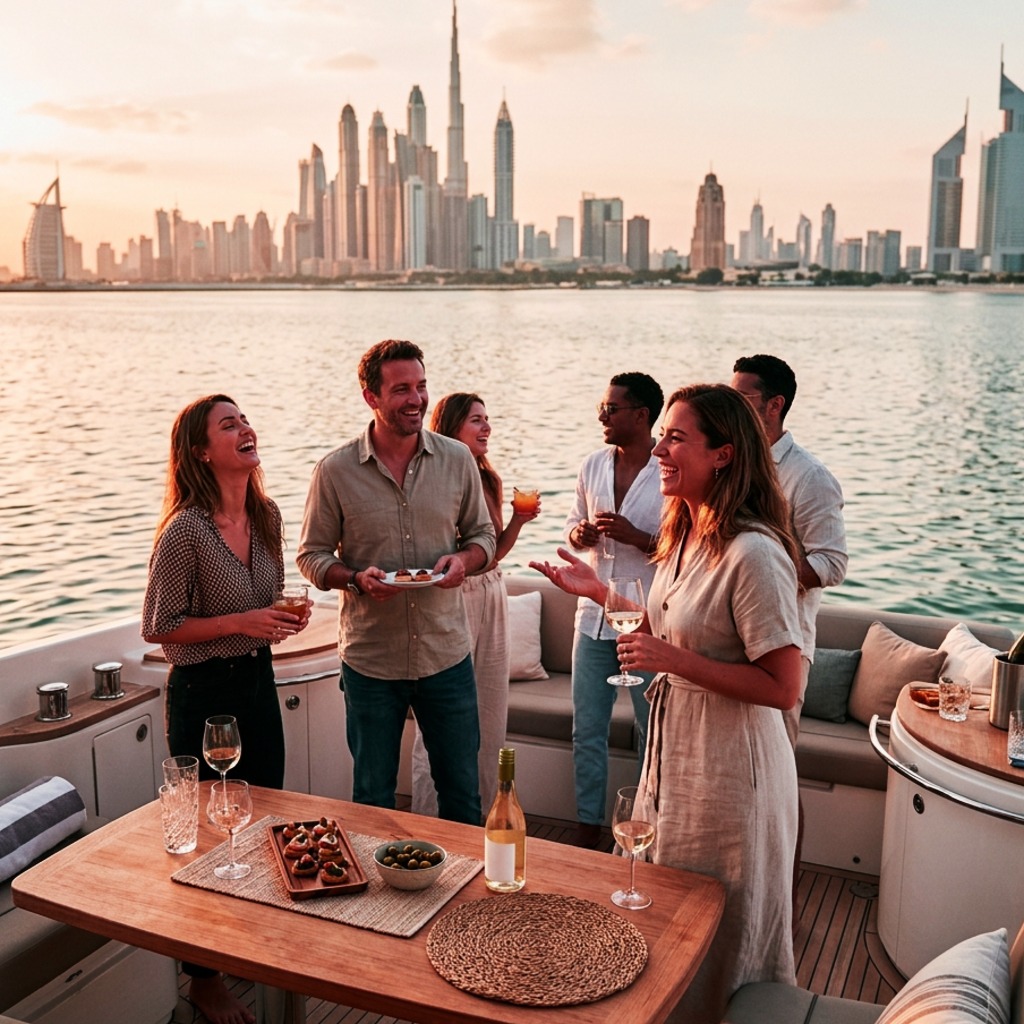
Saturday evening: dinner at sunset, then more discussion. The boat anchored where the city skyline was visible; the lights came on as they ate.
Sunday morning: final session, then a slow cruise back to the marina.
Total cost: roughly equivalent to a desert resort offsite for the same group. The experience was different.
What changed
The CEO's reflection at year one:
- Conversations were more honest. The setting reduced status barriers in ways the resort never had.
- Time felt different. The cruise legs created natural transition moments between formal sessions.
- No one was on their phone in the way they would be at a hotel. Connectivity was decent but the environment didn't reward it.
- Tired people came back energised rather than the usual mid-energy state from desert offsites.
- Team members talked about it for weeks afterwards. This was new.
The offsite ROI metrics — to the extent leadership offsites have ROI metrics — were stronger than previous years.
Year two
The leadership team voted unanimously for the boat option again. Same operator; same boat (where available); slightly modified format based on year-one learnings.
Year two refined the format:
- Less structured agenda; more conversational space
- One specific deliverable per attendee, due before re-boarding the marina
- A half-day of pure rest in the middle to avoid burnout
- A formal commitment ritual at the end of the weekend
The format worked even better in year two because the team knew the rhythm.
Year three
By year three, the boat offsite had become institutional. The HR director scheduled it 10 months ahead. Team members kept the dates clear before any other commitment.
The CEO noticed something: the offsite was producing more lasting effects than any other intervention he'd tried with the leadership team. People referenced commitments made on the boat throughout the year. Cross-team relationships were measurably better than at competitors.
What surprised them
A few patterns the team didn't expect:
1. The constraint was the feature. The boat is small. You can't avoid colleagues. That sounds claustrophobic; it became a feature. Difficult conversations had nowhere to be deferred to.
2. The setting changed roles. The CEO appreciated that for two days a year, he wasn't the highest-status person in the room — the captain was. The boat had its own hierarchy and the corporate one was suspended.
3. Phones got put away naturally. No one had asked anyone to put phones away. The setting did it.
4. Sleep quality was unusually good. Several team members reported the best sleep they'd had in months. Decisions made the next morning carried that.
5. The team retained more. Insights from boat offsites stuck longer. They referenced them six months later in a way they didn't reference desert offsite insights.
What they kept doing
By year five, the boat offsite was a non-negotiable line item. The CFO had argued once for going back to desert resorts on cost grounds — the boat was actually slightly more expensive. The CEO and HR director defended it on outcomes grounds.
The format had stabilised:
- 8-12 people, never more
- 18-22m boat with adequate cabin space
- Two days at minimum, three when possible
- Sheltered anchorage rather than marina-side
- Mix of structured sessions and unstructured time
- One captain plus one chef; minimal staff overhead
- Same cruise route every year (the team had favourite anchorages)
What they'd tell other companies
The CEO's advice to peers considering the same approach:
1. Pick the right boat. Not the largest; the right one. A boat that comfortably fits 10 is better than a boat designed for 20 with 10 aboard. Density helps the dynamic.
2. Don't over-program. The desert resort instinct is to fill the agenda. The boat instinct should be the opposite.
3. Use a captain you trust. The captain shapes the experience. Find one who reads the room and knows when to disappear.
4. Anchor; don't run charter to charter. Cruising for two days produces a different feel than spending a day at one anchor.
5. Don't expect quick adoption. Year one is a trial. Year two is when it becomes tradition. By year three it's culture.
What this illustrates
Corporate use of houseboats is a small but loyal segment of the UAE market. The companies that try it usually return. The reasons map closely to what makes private use work — the constraints, the slowness, the suspension of normal hierarchies — but applied to leadership group dynamics rather than family dynamics.
For boat owners considering offering their boat to corporate clients: the segment exists, the rates are good, and the wear-and-tear pattern is favourable (corporate users treat boats more carefully than typical Airbnb users). The operational complexity is moderate.
For HR leaders considering it for their own offsites: the experiment is worth running once. If it fits the team, it usually keeps fitting. If it doesn't fit, you'll know quickly.
The patterns are remarkably consistent across the companies we've watched make the move.
Have questions on anything in this piece? Send a note via /contact — we read every reply.
Written by
The 101Marine team
Field notes from the team that designs and builds 101Marine houseboats. We write when we have something practical to share.
More from Stories
See all →
Stories
Jeff Bezos, Blue Origin & the Rise of Luxury Life on Water: What Yacht Living Teaches Modern Entrepreneurs
What Jeff Bezos' yacht lifestyle reveals about modern success, privacy, mobility, and why entrepreneurs are increasingly drawn to life on water.
Stories
The captain career change — from corporate to operating a charter business
An archetypal study of one of the more dramatic professional pivots we see — corporate executives who buy a houseboat and end up operating it commercially as a second career.
Stories
A three-generation family on a houseboat — the tradition that compounds
An archetypal study of what changes — and what doesn't — when a family keeps the same houseboat across decades. The ritual, the wear, the children who grew up aboard.