
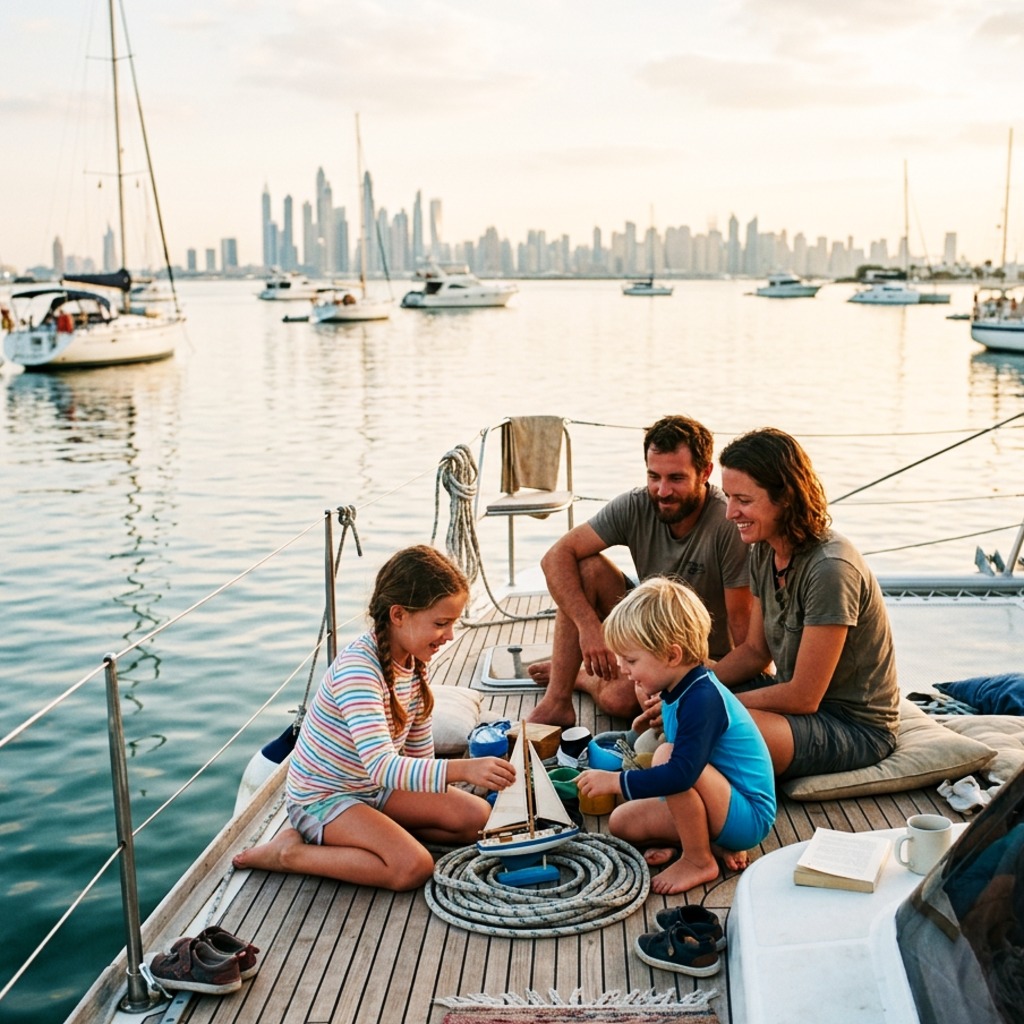
family · stories · long-term
A three-generation family on a houseboat — the tradition that compounds
An archetypal study of what changes — and what doesn't — when a family keeps the same houseboat across decades. The ritual, the wear, the children who grew up aboard.
This is another archetypal piece — drawn from the patterns we see in long-time owners whose houseboats have been part of family life across generations. The specifics are anonymised; the patterns are real.
The first generation
The owner — grandfather now, fifty-two when he bought the boat — had been thinking about it for a decade. His own father never owned a boat; the family was new money and the boat felt like a statement.
He bought conservatively. A 14-meter houseboat from an established UAE builder, mid-tier marina, deliberately understated finishes. The kind of boat you can use without worrying about scratching.
His wife was sceptical. Their two children — daughters, twelve and nine — were enthusiastic. The first weekend, the boat felt like everyone else's boat. By the third weekend, it felt like theirs.
The middle years
For ten years, the boat was the family's place. School holidays. Eid weekends. Birthdays. Birthday cakes blown out on the bridge deck. School friends aboard for the first time. The girls learning to swim off the swim platform. Bigger family gatherings — uncles, aunts, cousins — at iftar in Ramadan.
The wear started showing. Carpets needed replacing. The galley appliances were updated. The original AC was replaced at year 7. The owner did a full refit at year 8 — new electronics, new batteries, hull treatment, freshened interior.
After the refit, the boat was effectively new. The family relationship to it kept compounding.
The first child marries
The older daughter's wedding party was held on the boat. Nineteen people in formal dress on a boat designed for twelve in casual. Nobody minded.
The wedding photos are the boat's most-printed images. The bride and groom on the bow deck, the family on the bridge, the city skyline behind them. They've been framed in every family member's home since.
She and her new husband borrowed the boat for their first married anniversary. The grandfather watched them sail out from the marina and got slightly misty about it.
The grandchildren arrive
The first grandchild went on the boat at three months old. The grandfather built a small wooden box on the bridge deck specifically as a baby station — a place where the youngest could nap in the breeze.
By the time the second grandchild was old enough to remember anything, the boat was the family boat. Not the grandfather's; not the parents'. The family's. The kids didn't know any version of family weekends without it.
The grandfather's wife — once sceptical — became its biggest advocate. She kept the boat's interior — small touches, framed photos, the specific cushion arrangement. The interior aged but stayed consistent. New family members were absorbed into rhythms that had been established a decade earlier.
What the boat became
By year 18 of ownership, the boat had become something larger than its specifications:
- The place where every family member learned to swim
- The place where major announcements happened
- The place where the family ate together more often than at any house
- The place visiting relatives went first
- The place the grandchildren considered home in a way that was stronger than any specific apartment they'd lived in
The boat didn't get bigger or fancier. The family memories did.
The eventual question
Around year 17, the grandfather started discussing whether to upgrade. A larger boat would accommodate the now-fifteen-strong family more comfortably. A newer boat would have modern systems. The case was reasonable.
The family voted no. Not the grandfather; the children and the grandchildren. The boat was the boat. Replacing it was unthinkable.
The grandfather did a second major refit instead. New electronics, new batteries, refreshed interior, full hull treatment. The boat that emerged was effectively new again — for the second time. Year 19 was its second new lease on life.
What the second generation thinks
The older daughter — now in her late thirties, with her own family — has thought about buying her own houseboat. She's looked at boats. None of them have felt right.
She's realised her relationship to the family boat is part of why. Her own boat would be hers; the family boat is ours. She'd rather use the family boat occasionally with her parents than own a separate one that her kids would relate to differently.
The younger daughter, who lives abroad, comes back to the UAE specifically to spend time on the boat. The boat became the strongest reason to come home.
What the third generation will inherit
The grandfather is now in his seventies. The boat is twenty-three years old, still in regular use, in better mechanical condition than most ten-year-old boats because it's never been neglected. He's structured ownership so that the boat passes to the family rather than to a single heir — the next generation will use it together, the same way they always have.
Whether they keep it for thirty more years or sell it to fund a larger family boat is up to them. The grandfather's preference is clear but he's stopped advocating.
What he says, when asked: "The boat was the cheapest thing I ever bought. The memories are worth more than the boat ten times over."
What this tells us
The families with the strongest houseboat traditions share a few characteristics:
- They bought conservatively. A boat the family can grow into rather than aspire to.
- They prioritised use over status. Less impressive boat, more frequent use.
- They built rituals around it. Birthday traditions, Eid traditions, specific meals, specific anchorages.
- They invested in maintenance. The boat that lasts is the boat that gets refit on schedule.
- They resisted upgrade pressure. The family boat doesn't have to be the newest model.
Owners considering a houseboat for family reasons often ask whether the use-frequency will hold up over decades. The honest answer: it depends on the family, but the boats that become multi-generational are the ones that owners stop thinking about as assets and start thinking about as heirlooms.
That mental shift usually happens by year 5. Once it does, the upgrade question stops mattering.
A note for new owners
If you're buying a first family boat: don't over-spec. Don't over-buy. Buy a boat that fits the family you have, with room to grow into the family you'll have. Use it weekly. Develop traditions. Refit at year 5 and again at year 10.
In thirty years, that boat — or its second-generation equivalent — will be the most-photographed asset your family owns.
The maths of "is it worth it" gets easier with every year of use.
Have questions on anything in this piece? Send a note via /contact — we read every reply.
Written by
The 101Marine team
Field notes from the team that designs and builds 101Marine houseboats. We write when we have something practical to share.
More from Stories
See all →
Stories
Jeff Bezos, Blue Origin & the Rise of Luxury Life on Water: What Yacht Living Teaches Modern Entrepreneurs
What Jeff Bezos' yacht lifestyle reveals about modern success, privacy, mobility, and why entrepreneurs are increasingly drawn to life on water.
Stories
The captain career change — from corporate to operating a charter business
An archetypal study of one of the more dramatic professional pivots we see — corporate executives who buy a houseboat and end up operating it commercially as a second career.
Stories
The corporate retreat that became a yearly tradition
How one company's annual leadership offsite migrated from a desert resort to a houseboat — and why it kept coming back. An archetypal account.