
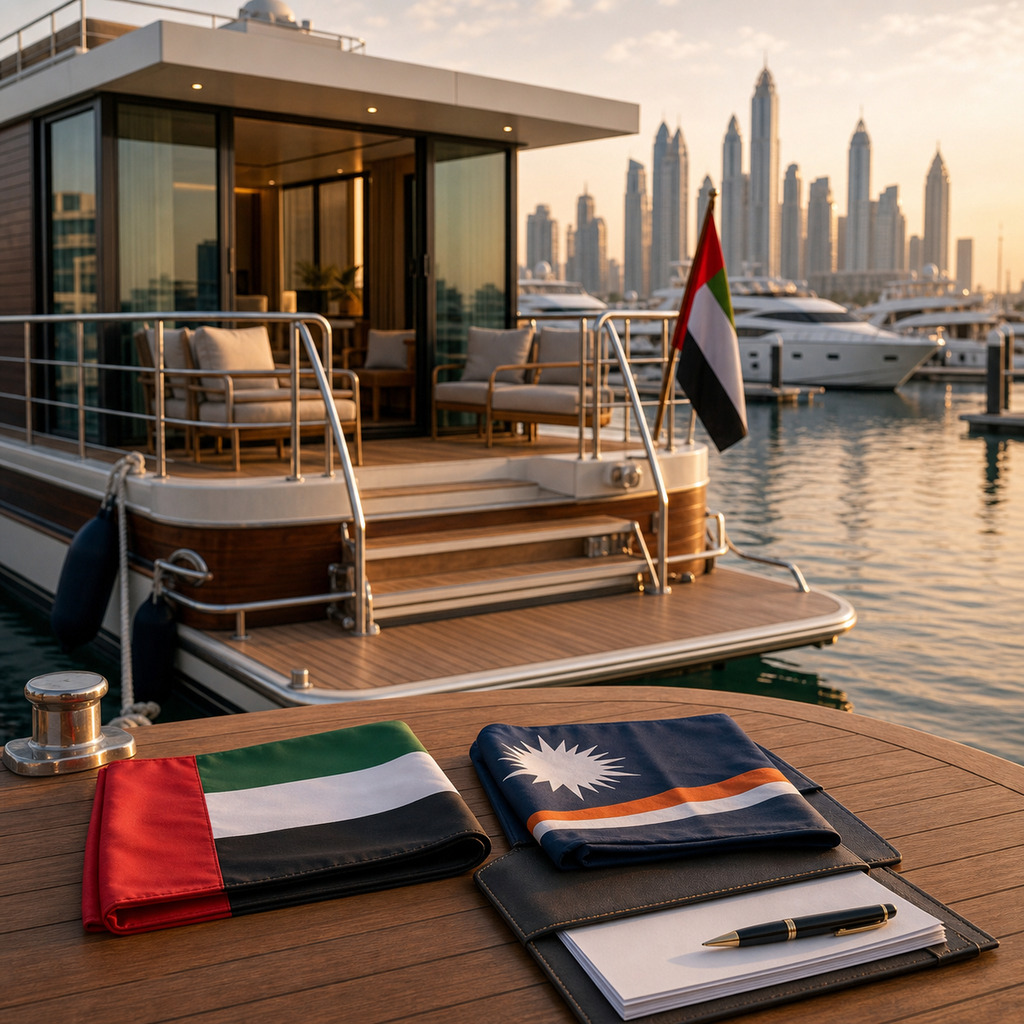
flagging · registration · ownership
Flagging a houseboat — UAE vs offshore registration
Personal preference, tax considerations, charter use, and resale. The factors that determine whether to flag your boat in the UAE or pick an offshore register.
Flagging — choosing which country's register your boat is registered under — is a question that confuses first-time buyers and matters more for some owners than others. For most UAE residents using the boat privately, UAE flag is the obvious answer. For some specific use cases, offshore registration is worth considering.
This is the working framework.
What flagging actually does
Your flag determines:
- Which country's safety and equipment standards you must meet
- Which country's commercial regulations apply (if you operate commercially)
- Which country's tax regime touches the boat
- Where the vessel is officially "from" for legal purposes
- Which courts handle disputes about the boat
- Which navy/coast guard nominally protects you in international waters
The flag does not determine where you can cruise — that's port-state jurisdiction, which any cruising vessel is subject to.
The realistic options for UAE-based houseboats
Three flagging routes cover almost all UAE owners:
UAE flag. Default for residents. Local registration through Federal Transport Authority (FTA) or the relevant Emirate's port authority. Fast, inexpensive, well-understood.
Marshall Islands. The most popular offshore option for Gulf-region private vessels. Strong reputation, established service infrastructure, accepted by most major insurance markets.
Cayman Islands. Premium offshore flag. More documentation, higher cost, but strong reputation in international yacht circles.
A handful of owners use other flags (Malta, Isle of Man) — usually because of specific business circumstances or because they cruise primarily in European waters.
When UAE flag is the right answer
For most UAE residents, UAE flag is the right answer. Specifically:
- You're a UAE resident
- The boat will be used primarily in UAE/GCC waters
- The boat is for private/family use
- You want the simplest paperwork and lowest cost
Pros: low setup cost (typically AED 3,000-5,000 plus annual fees), direct access to UAE FTA marine inspection, simplest customs and excise treatment, easy paperwork for cruising in GCC waters.
Cons: international cruising outside the GCC requires more paperwork than offshore flags. The UAE flag is less familiar to European or Caribbean port authorities. Some international charter platforms prefer offshore flags.
When offshore flag makes sense
A smaller subset of buyers benefits from offshore registration:
Commercial charter operations. International charter clients often expect a recognised commercial flag. Marshall Islands or Cayman is the standard.
Multi-jurisdictional cruising. If the boat will spend significant time outside GCC waters — Mediterranean cruising, Indian Ocean tours, Caribbean charter — an internationally-recognised flag simplifies port-state interactions.
Specific tax/inheritance structures. For owners with complex international tax positions, the right offshore vehicle can simplify estate planning and tax treatment. Consult with a tax adviser; this is jurisdiction-specific.
Asset isolation for liability purposes. A corporate vehicle in an offshore jurisdiction can isolate the boat from other personal assets in adverse legal scenarios. Less relevant for owners with conservative use; more relevant for charter operations or unusual exposure.
What offshore costs
Setup: USD 5,000-15,000 depending on flag and jurisdiction. Annual: USD 2,000-6,000 in flag fees, registration agent fees, and required filings.
The premium over UAE flag is roughly USD 15,000-50,000 over a 7-year ownership period. Worthwhile for the use cases above; not worthwhile for typical UAE-resident private use.
Where the flag conversation actually matters
Two specific scenarios deserve careful thought:
1. Buying a used offshore-flagged boat as a UAE owner.
Common scenario: a UAE buyer purchases a Marshall Islands-flagged boat from a previous owner. Two paths:
- Keep the boat under the existing flag. Continued offshore admin overhead, but no re-registration cost.
- Re-flag to UAE. Some paperwork; minor cost; simplifies day-to-day operation.
Most UAE-resident buyers re-flag to UAE for private use. The exception is if charter is part of the plan, in which case keeping the offshore flag may make sense.
2. UAE owner expanding into international charter.
If an owner starts thinking about chartering internationally — particularly outside GCC waters — re-flagging to a commercial-friendly offshore register often makes sense. The cost is modest; the benefit (smoother charter operations, broader insurance options, better presentation to international clients) is meaningful.
This is a decision better made before than after the first international charter season.
What flagging doesn't change
A few common misconceptions:
Crew/passenger liability still applies regardless of flag. UAE law applies in UAE waters; flagging offshore doesn't escape local liability rules.
Customs and import duties still apply at first import. Flagging offshore doesn't avoid the initial customs treatment when the boat enters UAE waters.
Insurance premiums vary slightly with flag, not dramatically. Offshore-flagged boats sometimes attract slightly lower P&I rates from international markets, but the difference is rarely the deciding factor.
The decision tree
A simple version:
- UAE resident, private use, GCC waters only? → UAE flag.
- UAE resident, planning international charter? → Marshall Islands or Cayman.
- Non-UAE owner, multi-jurisdiction use? → Marshall Islands or owner's home country.
- Buying a used offshore-flagged boat for private use? → Re-flag to UAE.
These cover 95% of buyers. The remainder are special cases (corporate ownership structures, dual residency, specific tax planning) that warrant professional advice.
A note on registration agents
For offshore flagging, a registration agent in the relevant jurisdiction handles the paperwork. Quality varies. Recommendations:
- Work with agents recommended by your shipyard or marine lawyer
- Verify they have current registration certifications with the flag state
- Get fee schedules in writing before committing
- Check responsiveness during a small request before larger paperwork
A good registration agent saves hours of paperwork friction. A poor one creates them.
Final pragmatism
For the typical UAE resident with a 15m houseboat used for family weekends in UAE waters, the flag question doesn't deserve much thought. UAE flag, register through FTA, get on with using the boat.
For owners with more complex circumstances, the question deserves careful consideration with proper advice. The right answer is rarely "the cheapest" — it's "the one that fits how I actually use the boat."
Have questions on anything in this piece? Send a note via /contact — we read every reply.
Written by
The 101Marine team
Field notes from the team that designs and builds 101Marine houseboats. We write when we have something practical to share.
More from Buying & Owning
See all →
Buying & Owning
From Yacht Culture to Houseboat Ventures: Why UAE Entrepreneurs Are Investing in Waterfront Business Assets
A practical look at how houseboats, floating lounges, and waterfront platforms can support hospitality, tourism, and private business experiences in the UAE.
Buying & Owning
Houseboat resale in the GCC — what holds value, what doesn't
The secondary market for UAE houseboats is small but consistent. Boats that hold value share specific characteristics; boats that don't share predictable failures. A study.

Buying & Owning
The mistakes new custom-build owners make (before construction even starts)
Most regrets in a custom houseboat trace back to decisions made before steel was cut. Five common patterns we've watched dozens of new owners walk into.