

charter · investment · management · ownership
Putting your houseboat in managed charter — what owners earn and pay
The charter-management arithmetic for UAE houseboats. Realistic earnings, realistic costs, and the trade-offs nobody mentions in the brochures.
One of the persistent questions from new houseboat buyers: "Can I let it out when I'm not using it?" The answer is yes, but the economics are more nuanced than charter management companies typically present.
This is the working version. UAE-specific. No salesy assumptions.
The basic structure
In a managed charter program, the operator handles bookings, crew, cleaning, and operations. The owner provides the boat. Revenue is split — typically 60/40 or 65/35 in the operator's favour after operating costs.
A typical UAE managed-charter relationship for a 15m houseboat looks like:
- Owner sets aside ~140 days per year for charter availability
- Operator targets 35-55 chartered days from those 140
- Day rates AED 4,500-7,500 depending on boat tier and season
- Operator covers crew, fuel for charters, cleaning, supplies
- Owner covers maintenance, insurance, berth fees, major repairs
Realistic gross revenue
For a well-positioned 15m houseboat:
- 45 chartered days × AED 6,000 average = AED 270,000 gross
- 35 chartered days × AED 5,000 average = AED 175,000 gross (lower utilisation)
So somewhere in the AED 175k-270k gross revenue range per year, with most owners landing around AED 200k once you adjust for ramp-up in the first year.
What the operator takes
After-cost split typically follows this pattern:
- Operating costs deducted first. Crew (AED 90,000-130,000 for a manned boat), charter fuel (AED 30-60k), cleaning between charters (AED 12-20k), supplies and consumables (AED 8-15k), marketing fees (typically 12-18% of bookings).
- Net revenue split between operator and owner — usually 60/40 to operator, sometimes 65/35.
For the AED 200k gross example:
- Operating costs: ~AED 130-180k
- Net to split: AED 20-70k
- Owner share: AED 8k-28k
That's the realistic range for an owner. Not the AED 100k+ that brochure projections sometimes suggest.
Why the brochures look better than reality
A few common patterns that inflate brochure projections:
Day rates assumed at peak season. Brochures show peak December rates; reality averages summer slack into the annual.
Utilisation assumed too high. "70% utilisation" in marketing materials translates to about 35% in reality after operational gaps, off-season, and owner use.
Operating costs underestimated. The captain salary, the cleaning, the supplies, the marketing fees — full accounting often gets skipped in projections.
Owner-pays items underestimated. Maintenance, insurance, berth fees that the owner continues to pay.
The realistic math is more conservative.
The maintenance multiplier
The hidden cost of charter is wear and tear. A boat used 45 days per year by paying customers ages roughly equivalent to a boat used 90 days per year by its owner. Customers don't treat boats as gently. Marina-side service costs run 30-50% higher.
Insurance also uplifts for charter use — typically 40-80% above private-use premium.
After honest accounting, a charter boat has roughly AED 30-50k more in annual maintenance and insurance vs the same boat in private use.
When charter actually pays
Charter management makes the most sense in three scenarios:
1. The boat would otherwise sit idle most of the year. If you'd use the boat 10-15 days per year and it would sit at the marina for the other 350, charter generates revenue from time the boat would have wasted anyway. Even modest revenue is upside.
2. The owner needs to offset specific costs. "I want the boat to cover its berth fees and insurance" is a realistic charter target. Generating AED 30-50k net annually is achievable and meaningful.
3. The owner is using charter as a sale-precursor. Boats in managed charter that the owner plans to sell within 2 years can recover useful revenue while the sale is set up. Not a long-term strategy.
When charter doesn't pay
1. The owner uses the boat regularly themselves. If you're using the boat 35+ days per year, the operational friction of charter (boat unavailable on demand, scheduling around bookings, insurance complications) usually outweighs the modest revenue.
2. The owner expects significant profit. Charter is rarely a profit centre at this scale; it's a cost-offset at best. Owners expecting "this will pay for itself" usually become disappointed in year two.
3. The owner has emotional attachment to the boat. Charter wear-and-tear is real. Boats come back from a busy season visibly tired. Owners who hate seeing their boat treated as someone else's holiday rental usually pull out within a year.
Operator selection
The single most important variable in charter economics is operator quality. Differences are large:
Top operators:
- Maintain transparent reporting
- Vet customers carefully
- Pay owners promptly
- Communicate about issues
- Maintain crew quality
Bad operators:
- Hidden fees in operating costs
- Poor customer screening (more wear and damage)
- Slow or incomplete payments
- Limited transparency
- Unstable crew
The difference in net to owner between a top-tier and a poor operator can be 50-100% on the same boat in the same season. Worth careful diligence at selection.
Owners considering charter should:
- Reference-check at least 3 existing clients of the operator
- Get the proposed contract reviewed by a marine lawyer
- Set clear expectations on customer profile and use limits
- Build in audit rights to confirm operator reporting
Hybrid models
Some owners find a middle path that works better than full charter management:
Owner-led with operator support. Owner books charters directly through their network; operator handles only the operational side (crew, cleaning, supplies). Higher gross retention, more owner workload.
Family-and-friends only. Boat is "chartered" only to the owner's social network. Cost-recovery rather than revenue. No operator involvement.
Seasonal charter. Boat in charter only during peak season (December-March) when day rates are highest, then private use the rest of the year. Less wear, better economics.
These hybrid models often beat full managed charter on owner economics.
The honest take
Charter is rarely the way to make a houseboat "pay for itself." It's a way to offset some costs, generate modest revenue from idle time, and contribute to the boat's economics if you're already going to own it.
For an owner buying a houseboat primarily for personal use: charter is a useful supplemental option. For an owner buying a houseboat primarily as a charter asset: the economics are tougher than the brochure suggests, and full-time commercial operators with multiple boats achieve better unit economics than single-boat owners.
If charter is part of the buying case, model it conservatively. Take projected revenue and discount by 30%. Take projected operating costs and inflate by 20%. The honest answer usually emerges from those adjustments.
What we recommend most often
For most UAE-resident houseboat buyers: don't anchor the buying decision on charter. Buy the boat for the use you actually want. Add charter later if it makes sense and the operator relationship feels right.
Owners who buy expecting charter to make the deal work usually end up buying the wrong boat for their actual use, or get squeezed on operations when charter underperforms expectations. Both outcomes are avoidable by buying for your real intent.
Have questions on anything in this piece? Send a note via /contact — we read every reply.
Written by
The 101Marine team
Field notes from the team that designs and builds 101Marine houseboats. We write when we have something practical to share.
More from Buying & Owning
See all →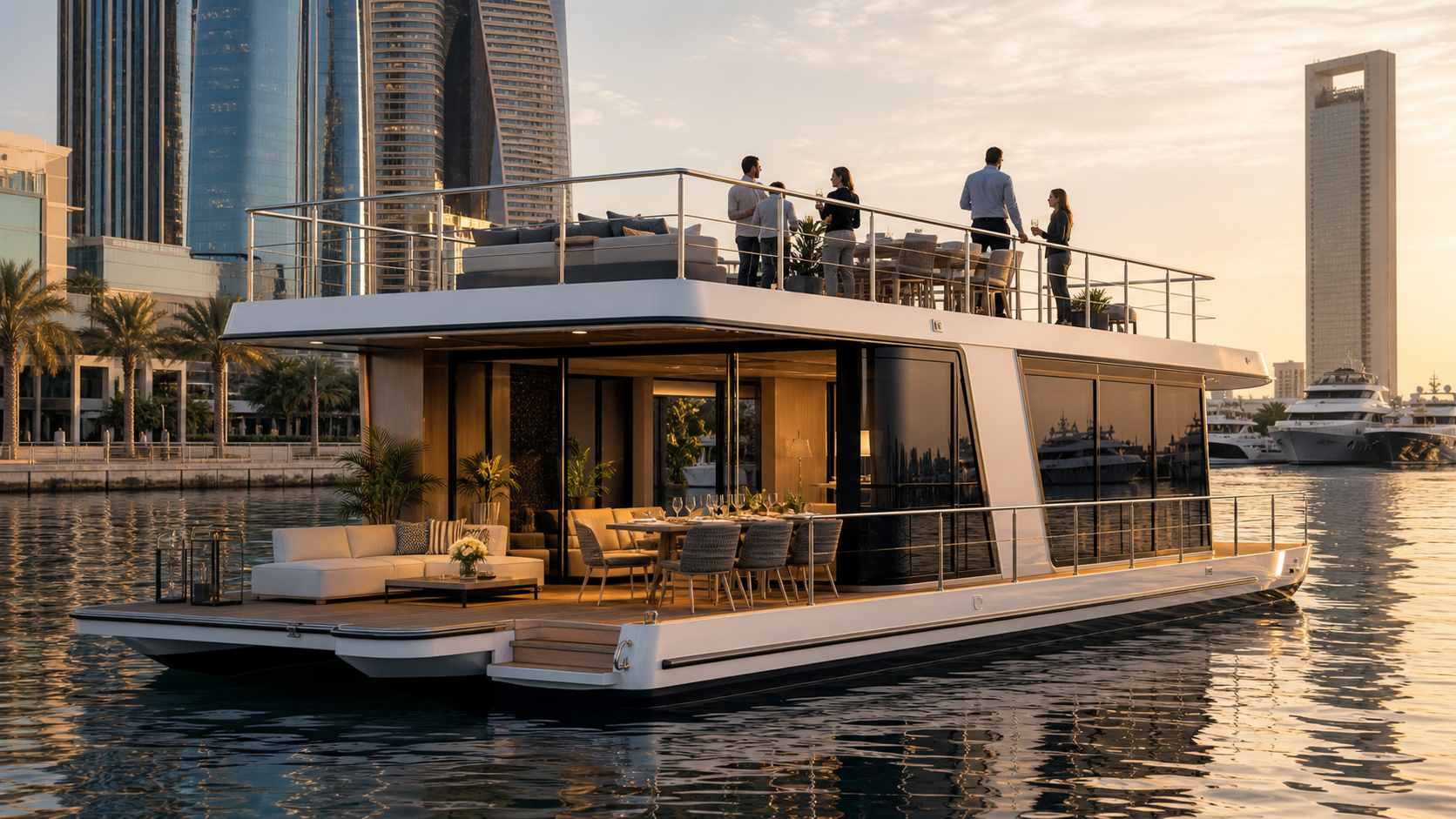
Buying & Owning
From Yacht Culture to Houseboat Ventures: Why UAE Entrepreneurs Are Investing in Waterfront Business Assets
A practical look at how houseboats, floating lounges, and waterfront platforms can support hospitality, tourism, and private business experiences in the UAE.
Buying & Owning
Houseboat resale in the GCC — what holds value, what doesn't
The secondary market for UAE houseboats is small but consistent. Boats that hold value share specific characteristics; boats that don't share predictable failures. A study.

Buying & Owning
The mistakes new custom-build owners make (before construction even starts)
Most regrets in a custom houseboat trace back to decisions made before steel was cut. Five common patterns we've watched dozens of new owners walk into.