
comparison · buyers · beginners
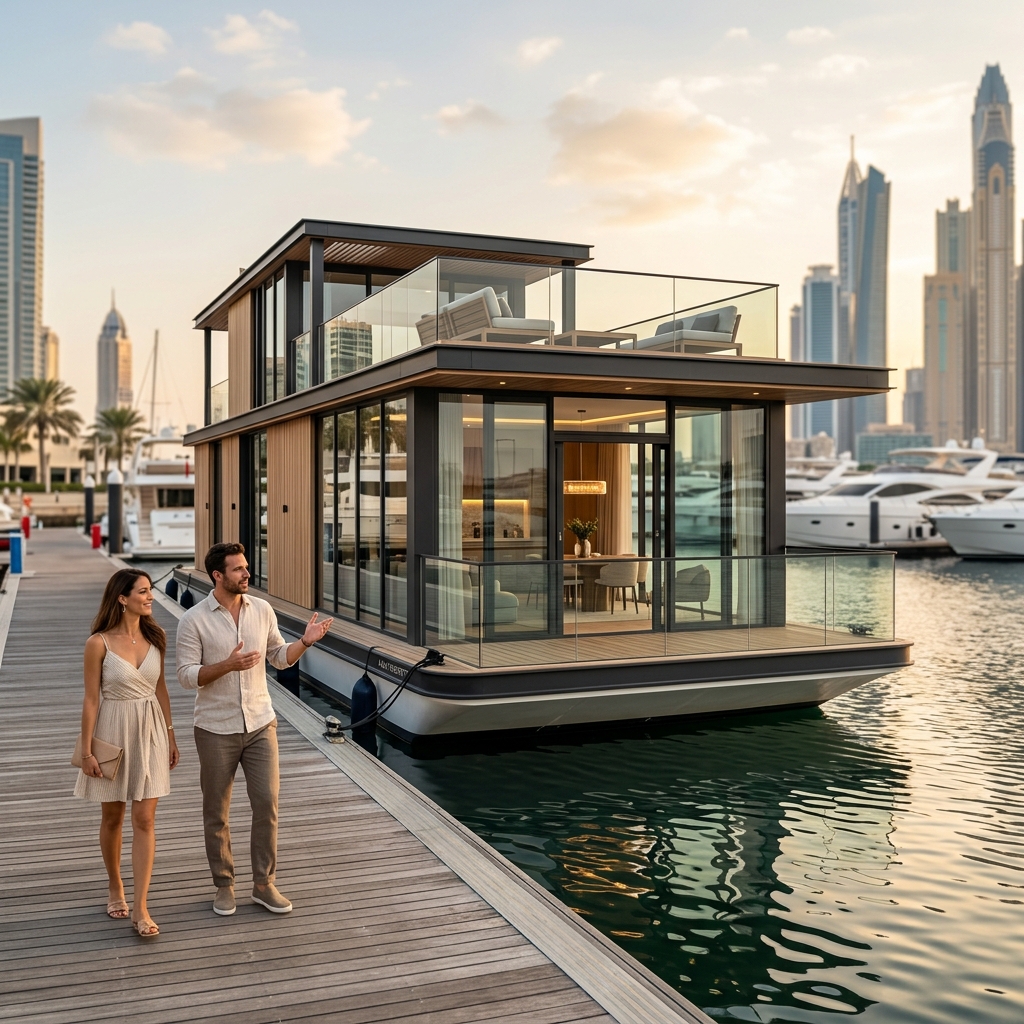
Houseboat vs yacht — which one fits your weekend?
They look similar in photos and behave very differently in real life. A practical comparison: speed, space, running cost, and which one wins for which kind of buyer.
The simplest version of the answer is this: a yacht is a vehicle, a houseboat is an address. They share the same waterway and almost nothing else.
If you're trying to decide between the two, the question isn't which is "better" — both can be excellent. It's which one matches the way you actually want to spend time on the water.
The fundamental difference
Yachts are designed for movement. Slim hulls, deep draft, planing or semi-displacement speed, performance fuel curves, helm-led layouts. The interior is comfortable but secondary. You buy a yacht to go somewhere.
Houseboats are designed for stopping. Wide beam, shallow draft, displacement-speed hulls, generous interior volumes, deck-led layouts. The cruising is in service of the destination — a weekend at anchor, a marina stay, a private dinner under the stars. You buy a houseboat to be somewhere.
This shows up in three places: speed, space, and economics.
Speed
A typical 50-foot motor yacht in the UAE cruises at 18–24 knots. The same length of houseboat cruises at 8–11 knots. That difference is decisive on long-range trips: a yacht goes from Dubai to Khasab in 3.5 hours; a houseboat goes in 7. Multiply by a return leg and you've burned a day each way on the houseboat.
But the maths flips for short trips. A 90-minute cruise from Mina Rashid to a quiet anchorage off Palm Jumeirah is the same in both — except the houseboat got there with the kettle already on, the deck lounge ready, and the AC settled.
Yachts win on range. Houseboats win on the journey to dinner.
Space
This is the lopsided comparison. A 50-foot houseboat has roughly the same usable interior square meterage as a 70-foot yacht. The wide beam and squared-off lines convert directly into living area: bigger salon, longer galley, full-walking-around-the-bed cabins. The aft and bridge decks scale similarly.
For owners who plan to entertain, sleep crews of 8–12, or spend full days on board, that volume difference is the entire decision.
For owners who plan to skim the water at 22 knots and drop anchor briefly for swimming, the volume is wasted on them.
Running cost
Yachts burn more fuel per nautical mile (planing speeds are inefficient) but typically use the boat for fewer hours per trip. Houseboats burn less per mile but tend to log more hours per use because cruising itself becomes part of the experience.
Per-year running cost for similar-priced boats works out roughly equivalent. The categories shift:
| Houseboat | Yacht | |
|---|---|---|
| Fuel | Lower | Higher |
| Crew | Often optional | Often necessary at 50ft+ |
| Berth | Beam-priced (more) | Length-priced (less for given footprint) |
| Maintenance | Lower (slower systems wear) | Higher (high-load engines, planing hulls) |
| Insurance | Slightly lower | Slightly higher |
For most buyers in the 12–20m range, total annual running cost lands within 10% of each other. The shape of the bill differs, the total doesn't.
Resale
Yachts depreciate faster in the early years and more slowly later — a typical curve hits 50% of new value at year 7. Houseboats hold value better in the first 3–4 years (the secondary market is small and demand exceeds supply in the UAE) but depreciate more steadily after that.
If you turn over boats every 3 years, yachts are the better resale story. If you keep a boat for a decade, houseboats are roughly even.
Five questions that decide it for most people
Do you want to travel or to settle? If your fantasy is anchored sundowners, kids jumping off the swim platform, dinners served on a bridge deck — that's a houseboat. If your fantasy is the engines roaring as you cross to Sir Bani Yas — that's a yacht.
How many guests, on average? Six or fewer favours a yacht (everyone's outside on the deck for the cruise). Eight or more favours a houseboat (you need indoor zones for some, outdoor zones for others, and somewhere quiet for whoever needs a nap).
Will you sleep aboard? Yachts can sleep four people comfortably; the cabins are crew quarters more than guest rooms. Houseboats sleep six or eight in proper cabins. If overnight stays are weekly, the cabin difference is decisive.
What's your home marina? Some UAE marinas charge by length, others by occupied area (length × beam). Check both before deciding — a 15m houseboat at a length-priced marina can be cheaper to berth than a 15m yacht at a beam-priced one.
Do you want to drive, or do you want to host? This is the question we ask most often. Owners who light up at "drive" usually buy yachts. Owners who light up at "host" usually buy houseboats. Owners who say "both" usually buy a houseboat first and add a tender for the driving.
The honest middle ground
Some owners want both, and that's fine. The most common combination in our market is a 15–18m houseboat as the primary platform, paired with a 7–10m centre-console tender stored on a davit or rear platform. The houseboat is the address, the tender is the vehicle. You drop anchor, drop the tender, drive the kids to a sandbar, come back for lunch.
It costs more than either solution alone but ends up being cheaper than upgrading a yacht to do houseboat duty (or vice versa).
The simplest decision rule
If you can't decide between a yacht and a houseboat, ask yourself this: at the end of a perfect weekend on the water, what photo do you want? The boat at speed, throwing wake? Or the boat at anchor, sun setting behind it?
Whichever image came to mind first, that's your answer.
Have questions on anything in this piece? Send a note via /contact — we read every reply.
Written by
The 101Marine team
Field notes from the team that designs and builds 101Marine houseboats. We write when we have something practical to share.
More from Buying & Owning
See all →
Buying & Owning
From Yacht Culture to Houseboat Ventures: Why UAE Entrepreneurs Are Investing in Waterfront Business Assets
A practical look at how houseboats, floating lounges, and waterfront platforms can support hospitality, tourism, and private business experiences in the UAE.
Buying & Owning
Houseboat resale in the GCC — what holds value, what doesn't
The secondary market for UAE houseboats is small but consistent. Boats that hold value share specific characteristics; boats that don't share predictable failures. A study.
Buying & Owning
The mistakes new custom-build owners make (before construction even starts)
Most regrets in a custom houseboat trace back to decisions made before steel was cut. Five common patterns we've watched dozens of new owners walk into.