
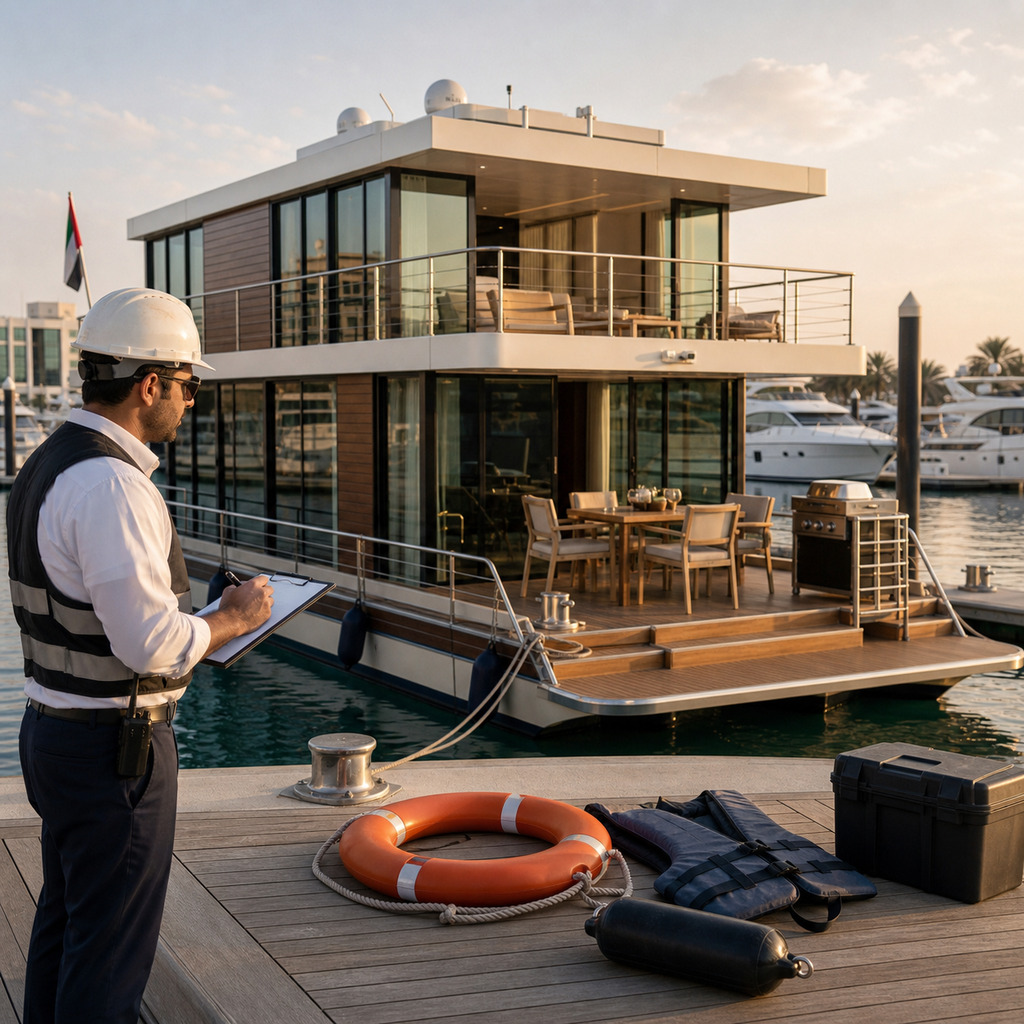
insurance · ownership · risk
Insurance options for UAE-flagged houseboats
Hull, liability, charter, and the lines that get missed. A practical primer on what each coverage actually does, and what owners should compare.
Marine insurance is one of the more opaque parts of houseboat ownership. The policies use unfamiliar terminology, the comparisons across providers are awkward, and most buyers pick the first quote that arrives. The differences between policies are bigger than they look.
This is the working orientation.
The four coverage types
Every houseboat owner needs four kinds of coverage:
Hull and machinery (H&M). Damage to the boat itself — collision, fire, weather, theft. The biggest single line on the premium.
Protection and indemnity (P&I). Liability — damage your boat causes to other vessels, property, or people. Often capped at AED 5-25M.
Personal accident. Coverage for injury to crew or passengers. Smaller limits typically.
Charter or commercial use (only if applicable). Specific coverage if the boat is used for paid passenger operation.
A typical UAE private-use policy bundles H&M, P&I, and personal accident; commercial coverage is added separately if needed.
What to compare across quotes
Not all "houseboat insurance" is the same. The differences hide in the terms.
Geographical limits. Where can you operate the boat? UAE-only is the cheapest; UAE+GCC is moderate; "Indian Ocean and Gulf" includes Oman, Iran, India, East Africa.
For UAE-based owners, the practical band is "UAE+GCC including Oman" — covering the realistic cruising envelope without paying for unneeded range.
Excess/deductible per claim. AED 5,000 to AED 100,000 depending on the policy and claim type. Higher excess = lower premium. For boats used regularly, mid-range excess is the right balance.
New-for-old vs depreciated. New-for-old replaces lost equipment at current new price. Depreciated values give you the depreciated value of what was lost. New-for-old is more expensive but less stressful in claims.
Salvage and wreck removal. Critically important. If a boat sinks, removal can cost AED 200,000-700,000. Make sure this is covered — some basic policies exclude or cap it heavily.
Personal effects. Coverage for personal items aboard. Useful for owners who keep electronics, art, fine wines aboard. Often a sub-limit (e.g. AED 30,000) within H&M.
Pollution liability. Coverage if your boat spills fuel or contaminates water. Specific to commercial operation in some markets; bundled into P&I in private-use policies.
Crew liability vs passenger liability. Different policies treat these differently. If you regularly have a captain or crew aboard, make sure crew liability is included rather than just passenger.
What a typical quote looks like
For a 15m UAE-flagged houseboat insured at AED 2.2M for private use:
- H&M premium: 0.9-1.4% of insured value = AED 19,800-30,800/year
- P&I: AED 3,000-7,000/year for AED 5-15M of liability
- Personal accident: AED 1,500-4,000/year
- Total annual: AED 24,000-42,000
The wide band reflects underwriter-specific pricing and the buyer's history. A first-time buyer typically lands at the higher end; an owner with 5 clean years lands at the lower.
What raises premiums
Predictable factors:
- First-time owner (6-12 month surcharge until you have a clean year)
- Charter or commercial use
- Boat over 12 years old
- Operating area extending to Iran, India, or East Africa
- Recent claims history
- Owner under 30 or over 70
What lowers premiums
Less obvious but meaningful:
- Marina with security/CCTV vs unsecured berth
- Approved alarm/tracking system
- Multi-year policy commitment (3-year vs annual)
- Combined with shipyard's preferred underwriter (we have referral relationships that often reduce the spread)
- Higher voluntary excess
A good broker can usually find 15-25% savings vs walking-up cold. Worth the introduction.
What to ask the broker (specifically)
Not all brokers are marine specialists. The questions that separate the specialists from the generalists:
- "What's the geographical limit, and what does it cost to extend to Oman?"
- "What's the salvage and wreck removal limit?"
- "Is replacement new-for-old or depreciated?"
- "How are crew vs passenger claims handled?"
- "What's the named storm/weather exclusion?"
- "What's the layup period requirement?" (some policies require the boat to be hauled or laid up part of the year — fine in northern waters, awkward in the UAE)
A broker who answers these confidently is comfortable in marine. A broker who hedges is selling a generic product.
The "named storm" question
Pay attention to weather exclusions. Some policies exclude damage from named tropical storms or cyclones unless specific precautions are taken. The UAE doesn't get hurricanes, but the Strait of Hormuz region occasionally sees significant weather, and Indian Ocean cyclones occasionally affect Oman.
Coverage that excludes any storm of windspeed >50 knots is more limited than it sounds.
Charter coverage
If you'll ever charter the boat — even casually for friends — your insurance probably needs to extend to commercial use. Private-use policies typically exclude any paid passenger operation.
The premium uplift for commercial charter coverage is meaningful (typically 40-80% above private), but trying to claim on a private policy after a charter incident leads to denial. If charter is even occasional, get the right policy.
Documentation owners should keep
In claims, paperwork wins or loses cases. Keep:
- Survey reports (builder's, pre-purchase, annual)
- Maintenance and service logs
- Photos at acquisition and after major refits
- Receipts for upgrades and additions
- Records of pre-departure inspections
- Crew credentials if applicable
A claim with full documentation pays in weeks. A claim without it can drag for months.
When to switch insurers
The temptation to switch annually for the lowest premium is usually wrong. Insurers reward continuous relationships with better claims handling and more flexibility on edge cases. Switch only when:
- The premium increase is materially out of line with market
- The insurer has demonstrably handled a recent claim poorly
- Your needs have changed (added charter, expanded geographical limits, etc.)
For most owners, a 3-5 year relationship with one insurer is the right cadence. Compare market every 3 years; switch only with reason.
What insurance won't fix
The most expensive insurance cannot replace careful operation. Most claims trace back to operational errors — improper anchoring, missed weather, unfamiliar harbour, inadequate crew briefing. Insurance pays the bill; you still lose the time, the boat for repair weeks, and often the no-claims discount.
Insurance is the safety net. Avoiding the fall is the actual job.
Have questions on anything in this piece? Send a note via /contact — we read every reply.
Written by
The 101Marine team
Field notes from the team that designs and builds 101Marine houseboats. We write when we have something practical to share.
More from Buying & Owning
See all →
Buying & Owning
From Yacht Culture to Houseboat Ventures: Why UAE Entrepreneurs Are Investing in Waterfront Business Assets
A practical look at how houseboats, floating lounges, and waterfront platforms can support hospitality, tourism, and private business experiences in the UAE.
Buying & Owning
Houseboat resale in the GCC — what holds value, what doesn't
The secondary market for UAE houseboats is small but consistent. Boats that hold value share specific characteristics; boats that don't share predictable failures. A study.
Buying & Owning
The mistakes new custom-build owners make (before construction even starts)
Most regrets in a custom houseboat trace back to decisions made before steel was cut. Five common patterns we've watched dozens of new owners walk into.