
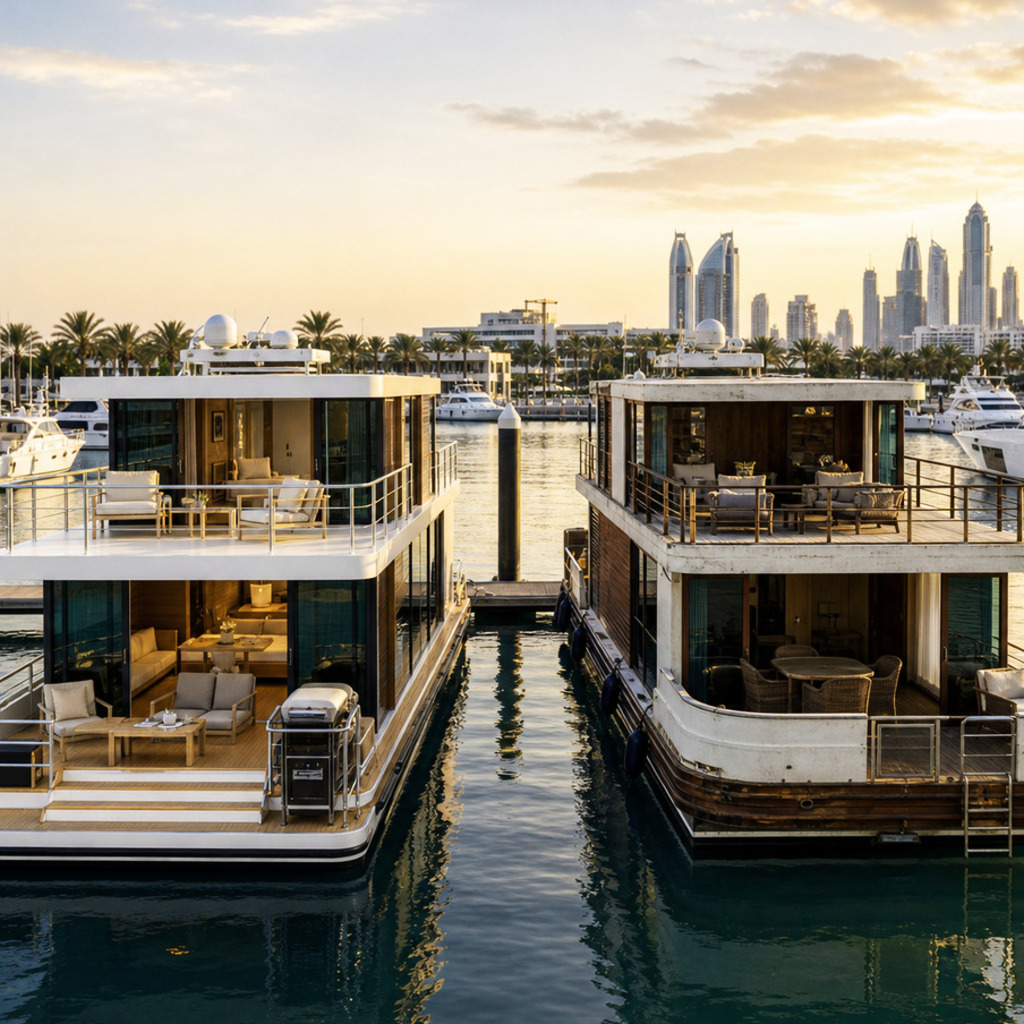
haulout · maintenance · service · yards
The annual haul-out playbook — what to inspect, who to use, what to expect
Your once-a-year hull-out-of-water moment. The right inspections, the right yard, the right schedule, and what separates a routine haul-out from one that uncovers expensive surprises.
The annual haul-out is the single most important maintenance event in a UAE houseboat's calendar. Done well, it catches problems early, refreshes the underwater finish, and lets the owner relax for the next 12 months. Done poorly, it misses problems that surface later at much higher cost.
This is the working playbook.
Why annual
In temperate climates, boats often go 18-24 months between haul-outs. In the UAE, the combination of warmer water, faster fouling, and faster corrosion means the right cadence is annual.
The cost is real but contained — typically AED 18,000-35,000 for a routine annual on a 15m houseboat. The savings vs deferred haul-outs are meaningful — usually 30-50% over a 5-year horizon.
When to schedule
October through February is the right window. Avoid:
- May-September: too hot for proper paint application; technicians less effective
- Ramadan: yard productivity is lower; scheduling is harder
- December peak holiday: yards are full; rates higher
Best months: November and February. Yards have capacity, weather is right, technicians are at full strength.
Book your slot 6-8 weeks ahead at minimum. Good yards fill their high-season schedule early.
What to inspect
A proper annual haul-out covers:
Hull and underwater surfaces:
- Antifouling condition (note worn areas)
- Hull integrity (cracks, blisters, gel coat damage)
- Through-hull fittings (corrosion, integrity)
- Sacrificial anodes (zincs) — replace if more than 30% consumed
Running gear:
- Propeller condition and balance
- Shaft alignment
- Cutless bearings
- Rudder bearings and seals
Seacocks and through-hulls:
- Operate every seacock
- Check valve integrity
- Inspect through-hull fittings from inside
- Replace any showing corrosion
Cooling water systems:
- Strainer condition
- Sea chests if fitted
- Raw water pump impellers
Steering systems:
- Hydraulic seals
- Linkage integrity
- Backup steering
Electrical:
- Battery health diagnostic
- Bonding system continuity (critical for corrosion prevention)
- Visible wiring inspection
This list seems long but a proper yard works through it in 2-3 days.
Who to use
Yard quality matters significantly. Indicators of a good yard:
- Marine-only specialism. Yards that work on cars, boats, and equipment together do none of them well.
- Track record with houseboats specifically. Houseboats have different requirements than yachts; yards specialising in race-yacht maintenance often miss houseboat-specific issues.
- Transparent quoting. Detailed scope and itemised quote up-front. Yards that give vague verbal quotes typically over-bill.
- Technician depth. Multi-day work shouldn't depend on a single person.
- Parts handling. Good yards source parts efficiently; bad yards add weeks to schedules waiting for orders.
- Communication. Daily updates during the haul-out. No surprises at the end.
UAE has 3-4 yards with the depth and consistency for serious houseboat work. They book up early. Develop the relationship; it pays back across years.
What to bring
When you deliver the boat for haul-out, bring:
- Maintenance log. What's been done since last haul-out.
- Specific concerns list. Things you've noticed that you want investigated.
- Service history of major systems. Engine service intervals, electrical work, recent repairs.
- Insurance documentation. Some yard work claims fall under hull insurance.
- Spare keys. Yard staff need access to all areas.
What you should be told
A good yard provides:
- Pre-haul inspection. A walk-around with the yard manager, noting points of interest.
- Daily updates. Photos, observations, any unexpected findings.
- Detailed quote for unscheduled work. Anything beyond the standard scope quoted before work begins.
- Final report. What was done, what was observed, recommendations for next interval.
Yards that don't provide these are operating below the standard you should expect.
What surprises owners
A few items that regularly surprise first-time haul-out owners:
Anode (zinc) consumption. Sacrificial anodes are designed to corrode in place of the boat's metalwork. Owners often see them and assume major corrosion problem. They're working as intended.
Antifouling thinness. Antifouling that looked complete from the water often shows wear when the boat is out. Half the surface area might need refresh.
Through-hull fittings. These look fine from above but show their age underneath. Plan to replace 1-2 fittings during a 5-year ownership; plan all of them at year 10-12.
Stuffing box condition. The seal where the propeller shaft exits the hull. Common to need refresh during haul-out; not always known in advance.
Hull blisters. Small osmotic blisters in the gel coat. Cosmetic mostly; if extensive, requires intervention.
Cost expectations
For a routine annual haul-out on a 15m houseboat, with no major surprises:
- Haul, pressure wash, splash: AED 4,500-7,500
- Antifouling reapplication: AED 18,000-32,000
- Anode replacement: AED 1,500-3,000
- Through-hull and seacock service: AED 2,500-5,500
- Inspection labour: AED 3,500-7,000
- Routine total: AED 30,000-55,000
Surprises that show up:
- Stuffing box rebuild: +AED 4,000-8,000
- Propeller repair: +AED 5,000-15,000
- Significant gel coat work: +AED 12,000-40,000
- Emergency through-hull replacement: +AED 8,000-15,000
Budget AED 40,000 for the routine; have an additional AED 25-50,000 available for surprises. Most years the surprise budget isn't fully used; the years it is, you're glad it was there.
What separates good from great
The difference between a routine annual haul-out and a thorough one:
Routine — Antifouling refresh, anodes, basic inspection, splash.
Thorough — All of the above plus:
- Compounded gel coat polish on topsides above waterline
- Hull surface fairing in any worn areas
- Detailed bonding system check
- Bilge pump service
- Through-hull integrity testing (not just visual)
- Pressure test of seacocks under operating conditions
- Steering hydraulic fluid replacement if scheduled
The thorough version costs 25-40% more. It also catches 70-80% more issues. For owners with multi-year horizons, the thorough version is the better economic choice.
After the haul-out
Once the boat splashes:
- Sea trial. Don't wait until the next trip. Run the engines, exercise the systems, confirm everything works as expected.
- Document. Photos, the yard's report, your own observations.
- Schedule next year. Most owners book the next haul-out before they leave the yard for the current one.
The post-haul-out trial often reveals things to address before the boat goes back into regular service. Better to find them at the dock than at sea.
When to skip the annual
Almost never. The cases where deferral is reasonable:
- Boat used minimally over the past year (under 10 days of operation)
- Recent thorough refit with antifouling refresh
- Owner-managed inspection with photos showing condition is good
Even in these cases, going to 18 months rather than skipping entirely is the better call. Annual is the right cadence for the UAE.
The compound value
Owners who haul annually have boats that look and function like much-newer boats well into year 8-10. Owners who skip or extend intervals have boats that age visibly faster.
The annual haul-out is one of the highest-value-per-AED items in the maintenance calendar. Don't skip it.
Have questions on anything in this piece? Send a note via /contact — we read every reply.
Written by
The 101Marine team
Field notes from the team that designs and builds 101Marine houseboats. We write when we have something practical to share.
More from Maintenance & Tech
See all →
Maintenance & Tech
Wood, gel coat, leather, fabric — what survives the Gulf, what doesn't
Material specification on a UAE-bound houseboat is a different problem than in temperate climates. Heat, UV, salt, and humidity reward some choices and punish others quickly.
Maintenance & Tech
The case for hybrid drives in houseboats — silent overnight, predictable economy
Hybrid diesel-electric installations on houseboats deliver silent overnight operation and meaningful fuel savings. The realistic version: where they win, where they don't.
Maintenance & Tech
The 30-minute pre-departure check that prevents 90% of trouble
A printable working checklist — engine room, deck, electrical, safety, weather. The owner habits that catch problems before they leave the dock.