
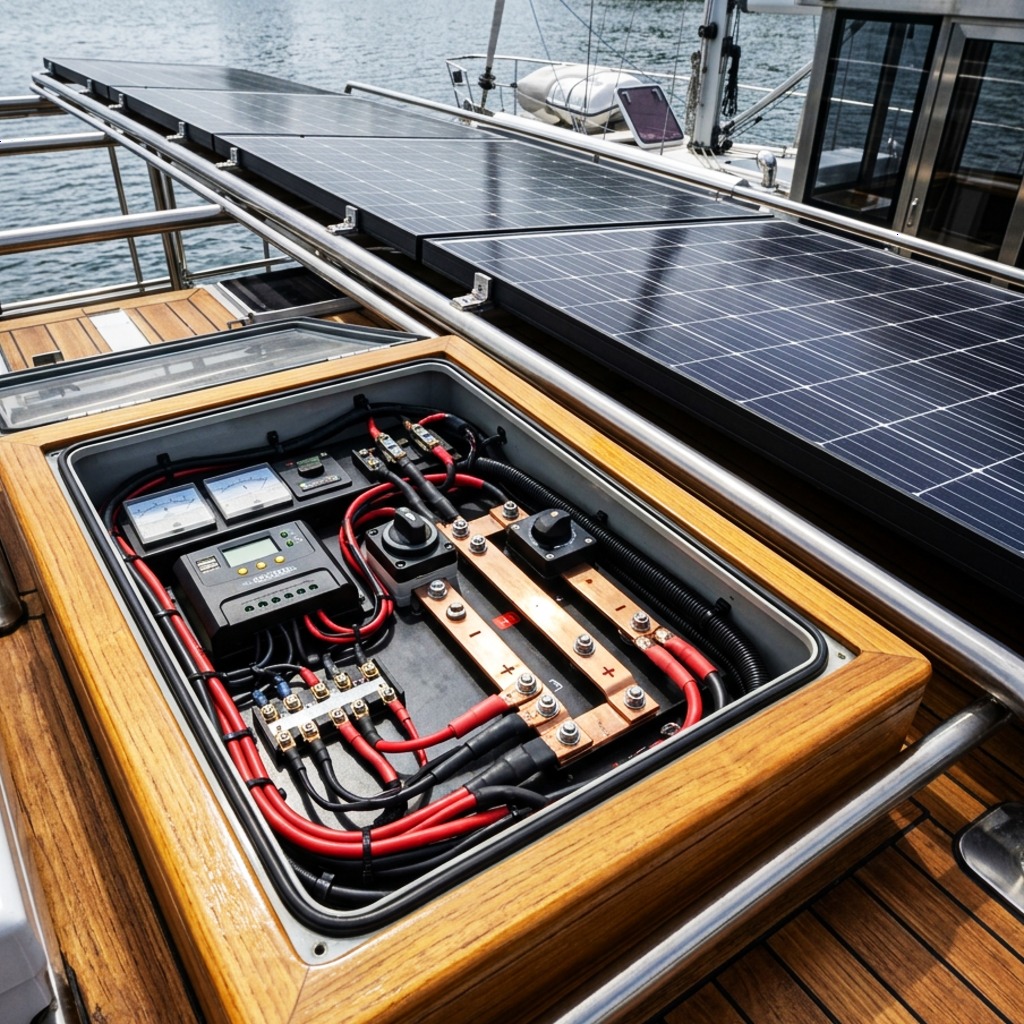
batteries · lithium · agm · electrical
Marine batteries in 50°C summers — lithium vs AGM, what actually lasts
Battery technology choice is one of the biggest practical decisions on a UAE houseboat. The realistic comparison: lifecycle, cost, weight, charging, and which one fits which use.
For UAE houseboats, the battery technology decision is a meaningful one. The two practical options — AGM (absorbed glass mat) and lithium iron phosphate (LiFePO4) — perform very differently in summer heat, charge differently, age differently, and cost very differently up-front.
This is the working comparison.
The 50°C reality
Summer temperatures in a battery compartment on a UAE boat regularly exceed 50°C ambient — particularly in the engine room or in poorly-ventilated lazarettes. Both technologies are stressed at these temperatures, but they fail differently.
AGM at 50°C: Self-discharge rate roughly doubles. Cycle life roughly halves vs nominal spec. A 10-year-rated AGM bank in spec conditions becomes a 5-year bank in UAE summer reality.
Lithium at 50°C: Charging slows or pauses (BMS protective behaviour); cycle life reduces but less dramatically (~25% reduction vs spec). Most lithium banks in UAE service achieve 80-90% of rated cycle life.
The temperature factor alone tilts toward lithium for UAE installations.
Up-front cost
For a typical 15m houseboat house bank (sizing for 24-48 hours of moderate AC use at anchor):
AGM equivalent: Roughly 12-16 kWh capacity in usable terms, requires 24-32 kWh nominal (50% depth-of-discharge limit). 8-10 large-format AGM batteries. Bank cost: AED 25,000-40,000 installed.
Lithium equivalent: 12-16 kWh capacity in usable terms, requires 14-18 kWh nominal (80-90% DoD acceptable). 1-2 lithium batteries with integrated BMS. Bank cost: AED 65,000-95,000 installed.
The lithium up-front premium is real — roughly 2-3x AGM cost. That's the headline number.
Lifecycle cost
The premium reverses on lifecycle:
AGM in UAE conditions: Realistic life 4-6 years before noticeable capacity loss (say, dropping to 70% of original capacity). Replacement at year 5-6.
Lithium in UAE conditions: Realistic life 8-12 years before similar capacity loss. Replacement at year 9-10.
Over a typical 10-year ownership, an AGM bank gets replaced once or twice. A lithium bank gets replaced once or not at all.
10-year cumulative battery cost:
- AGM: AED 25-40k initial + AED 25-40k replacement at year 5 + possibly another at year 10 = AED 50-80k
- Lithium: AED 65-95k initial + possibly nothing else = AED 65-95k
The lifecycle cost is comparable. AGM may actually be slightly cheaper if you replace once in 10 years; lithium is slightly cheaper if you replace twice. Cost is roughly a wash over the long term.
The difference is when the cost falls.
Weight
The weight difference is dramatic:
- A 24 kWh nominal AGM bank weighs around 290-350 kg
- The equivalent 16 kWh nominal lithium bank weighs around 130-150 kg
For a houseboat, 150-200 kg of saved weight is meaningful — slightly better fuel economy, slightly more flexibility on payload, and the weight comes off the deepest part of the hull (helping stability margins).
Charging behaviour
This is where real-world experience diverges most.
AGM charging: Accepts charge at moderate rates. Charges in distinct stages (bulk, absorption, float). Last 20% of charge is slow — bulk charging tapers significantly. Practical implication: a depleted AGM bank takes 6-10 hours of generator time to fully recharge. That's a lot of generator running.
Lithium charging: Accepts charge much faster. No taper at the top end of charge curve (until BMS limits kick in). Practical implication: a depleted lithium bank fully recharges in 2-4 hours of generator time.
For owners using AC overnight at anchor, the lithium charging speed matters significantly. Less generator runtime = less fuel = quieter mornings = less wear on the genset.
Solar interaction
Solar panel output and battery acceptance match up differently:
AGM: Slow to absorb solar in late afternoon when it's available. Generation that exceeds AGM acceptance is wasted unless dumped to a load.
Lithium: Accepts solar at full panel output. Most solar generation gets stored.
For boats with meaningful solar (1.5+ kW), lithium captures roughly 40-60% more useful energy from the same panel array.
The "drop-in" question
Marketing of lithium batteries sometimes suggests they're "drop-in" replacements for AGM. Reality is more nuanced.
For a small bank (single battery replacement on a smaller boat), drop-in is sometimes feasible. For a meaningful house bank on a houseboat, lithium installations require:
- A new charger compatible with lithium charge profile
- Possibly a new alternator regulator
- Reconfigured battery monitoring
- BMS-aware boat protection logic
- Often new bus bars and cabling sized for higher currents
The full conversion is more involved than swapping batteries. Plan for AED 15-25k of supporting work beyond the batteries themselves.
Failure modes
Worth understanding how each fails:
AGM failure is gradual. Capacity declines steadily; specific gravity drops; battery monitor shows progressively shorter runtime. You see it coming for months.
Lithium failure is more binary. Cells fail individually; BMS may shut the whole bank down. You may have 90% capacity for years and then a sudden dramatic drop.
The good news: failed lithium cells in modern banks can sometimes be replaced individually rather than replacing the whole bank. The bad news: when a bank starts failing, options are more limited and parts harder to source quickly.
Which to choose
A practical decision matrix:
Choose AGM if:
- Budget-constrained at the build phase
- Boat usage is mostly marina-side (less stress on the bank)
- You're comfortable with replacement at year 5-6
- The boat is likely to be sold before year 8
Choose lithium if:
- The boat has meaningful solar
- You spend nights at anchor regularly
- Generator quietness/runtime matters
- Long ownership horizon (8+ years)
- You can absorb the up-front cost
For most new builds in our shipyard, lithium is now the default specification. The arguments for AGM in 2025-2026 are increasingly narrow.
A note on hybrid banks
Some installations combine lithium for the heavy-cycling house bank and AGM for engine starter banks. This is a perfectly reasonable architecture. Starter batteries don't deep-cycle; AGM is fine for that role and cheaper. The house bank where deep cycling happens benefits most from lithium.
When to upgrade
Existing AGM banks reaching end-of-life are the natural moment to consider lithium. The upgrade work happens once; the supporting infrastructure (charger, alternator regulator) gets done at the same time.
For owners with healthy AGM banks: there's no urgent reason to upgrade until the bank ages out. Plan the conversion for the eventual replacement timing.
For new builds: spec lithium from the start. Building lithium-aware electrical from day one is significantly cheaper than retrofitting later.
The honest summary
Lithium has become the right answer for most UAE houseboats. The up-front cost is real but the lifecycle economics are competitive, the operational benefits (charging speed, solar capture, weight, generator runtime) are meaningful, and the heat tolerance suits Gulf conditions specifically. AGM still has narrow niches but is no longer the default specification we'd recommend.
If you're building new or replacing an aged bank, lithium is almost certainly the right call.
Have questions on anything in this piece? Send a note via /contact — we read every reply.
Written by
The 101Marine team
Field notes from the team that designs and builds 101Marine houseboats. We write when we have something practical to share.
More from Maintenance & Tech
See all →
Maintenance & Tech
Wood, gel coat, leather, fabric — what survives the Gulf, what doesn't
Material specification on a UAE-bound houseboat is a different problem than in temperate climates. Heat, UV, salt, and humidity reward some choices and punish others quickly.
Maintenance & Tech
The case for hybrid drives in houseboats — silent overnight, predictable economy
Hybrid diesel-electric installations on houseboats deliver silent overnight operation and meaningful fuel savings. The realistic version: where they win, where they don't.
Maintenance & Tech
The 30-minute pre-departure check that prevents 90% of trouble
A printable working checklist — engine room, deck, electrical, safety, weather. The owner habits that catch problems before they leave the dock.