
solar · electrical · tech · sustainability
Solar on a houseboat — when it pays off, when it doesn't
Marine solar is oversold to new owners and undersold to old-hand owners. Here's the actual math: generation rates in the UAE, what it offsets, when the ROI lands.
Solar panels look obvious on paper. The UAE gets sun. Boats sit in the sun. Fuel is expensive. Therefore, solar.
The reality is more interesting and more conditional. Solar pays off well for some houseboat use patterns, breaks even for others, and loses money for a third. Understanding which one you have is the whole game.
What solar actually generates on a houseboat in the UAE
A high-quality marine solar panel produces about 75–85% of its rated wattage at solar noon in clear conditions in the Gulf. After dust accumulation, partial shading from rigging or canopies, and sub-optimal panel angle, average daily generation lands at:
- 300W panel — 1.4 to 1.7 kWh per day, year-round average
- 800W array (3 × 270W panels) — 3.7 to 4.5 kWh per day
- 1.5 kW array (typical for a 15m houseboat sky deck) — 7 to 9 kWh per day
- 3 kW array (full sky-deck coverage on an 18–20m boat) — 14 to 18 kWh per day
These numbers fall by about 15% in the haziest summer weeks and rise by about 10% in the clearest winter weeks. Day-to-day variation in the UAE is small compared to the Mediterranean — one of the genuine advantages of cruising here.
What that energy actually offsets
The interesting question is what 8 kWh/day of free electricity covers. Roughly:
- Refrigerator + freezer (24h): 2.5–3.5 kWh
- Lighting + small electronics (evening use): 0.5–1 kWh
- Water pump + small accessories: 0.3–0.5 kWh
- Marine AC (typical 12,000 BTU unit, 3 hours): 4–5 kWh
- Marine AC (full overnight, 8 hours): 12–18 kWh
Read carefully: an 8 kWh/day array can run your fridge, lights, water, and a few hours of AC. It cannot, on its own, run AC overnight. The AC question is the entire economic argument.
The three usage patterns
Pattern A — Marina use, hardly ever at anchor. Solar offsets shore power at the dock. Shore power in UAE marinas runs roughly AED 0.40–0.60 per kWh depending on the marina. A 1.5 kW array generating 8 kWh/day saves AED 3.20–4.80 per day, or AED 1,200–1,800 per year. Against a typical install cost of AED 18,000–28,000, payback lands at 12–18 years. Solar does not pay off in this scenario before the panels age out.
Pattern B — Mixed use, weekend anchor stays, AC running overnight from the genset. Solar replaces some of the genset's daytime burden, lets the battery bank hold more reserve overnight, and reduces total genset hours by 20–30%. Genset fuel and maintenance savings come to AED 4,000–7,000 per year. Add the marina-power offset and you're at AED 5,500–9,000 per year in savings. Payback: 3–5 years. Solar pays off comfortably in this scenario.
Pattern C — Long-stay anchoring, multi-day trips, silent overnight a priority. This is the case where solar earns its keep loudly. Combined with a properly-sized lithium house bank, a 3 kW array can power most of a long anchor stay without genset use beyond a quick top-up at noon. Owners in this category typically save AED 12,000–20,000 per year in fuel and maintenance, plus the harder-to-quantify benefit of silent nights. Payback: 18–30 months. Solar transforms the experience in this scenario.
The battery question
Solar without a battery upgrade is half a system. The battery bank needs to:
- Be able to absorb the daytime generation (lithium handles fast charging far better than AGM)
- Have enough usable capacity to hold a day's generation through the evening
- Survive the cycle count without degrading
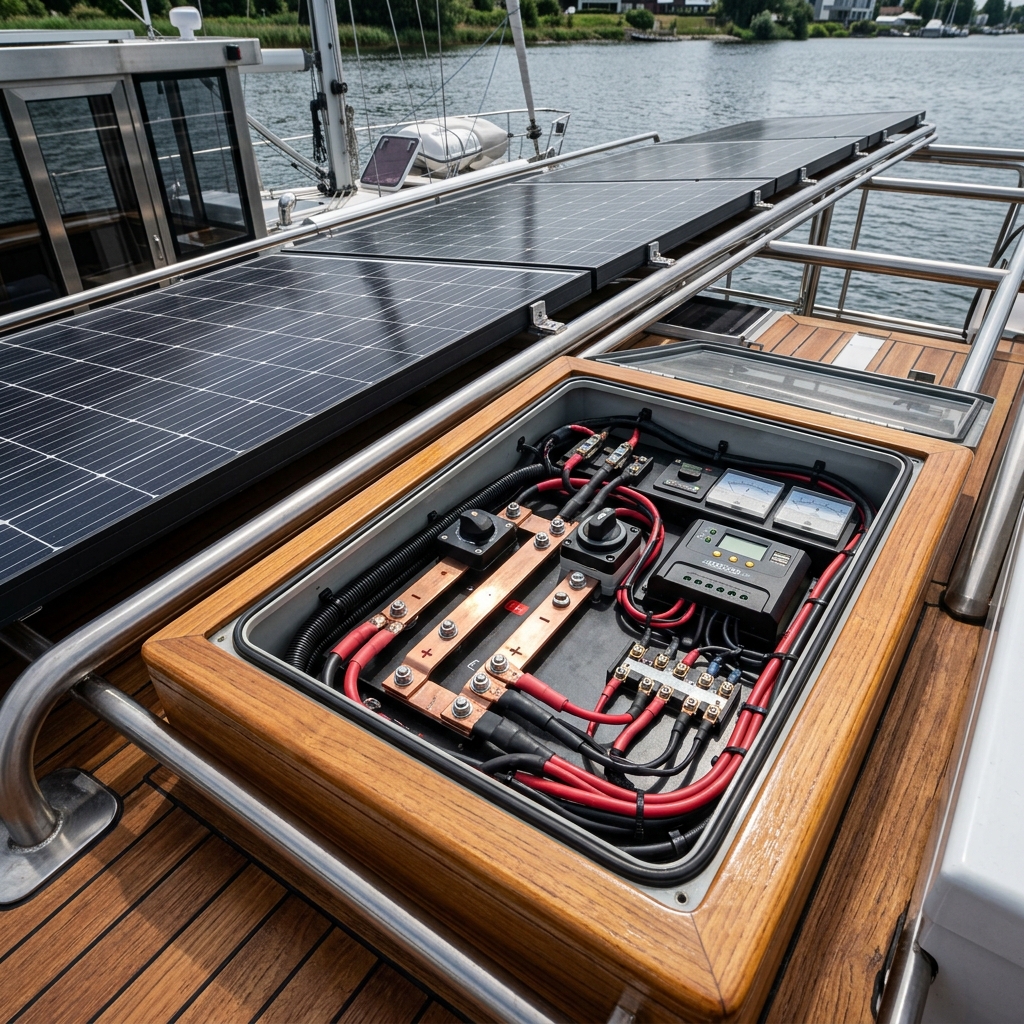
For most houseboats, this means upgrading the house bank to lithium at the same time as installing solar. Lithium house banks for a 15m boat typically cost AED 35,000–55,000 fitted. Treat the solar + lithium as one system economically — the ROI calculations only work when both are factored in.
Installation considerations specific to the UAE
- Heat. Marine solar panels are rated for 25 °C. They lose 0.4% efficiency for every degree above that. At a 60 °C panel temperature on a still summer afternoon (entirely common in the UAE), you're losing 14% of theoretical output. Mounting that allows airflow underneath helps significantly.
- Dust. A panel array left uncleaned for two months can lose 15–20% of its output. Plan for a monthly hose-down at minimum, weekly during the shamal season.
- Salt. Marine-grade panels and connectors only — domestic rooftop kit corrodes within a season. Verify IP ratings of every component.
- Shade tolerance. Some panels handle partial shading (from a flagpole, rigging, antenna) much better than others. MPPT controllers and panel-level optimisers earn back their cost on any boat with deck obstructions.
What it can't do
A few myths worth dispelling:
- Solar will not power an inverter air conditioner all day at 50 °C ambient unless you have an unusually large array (4 kW+). The AC duty cycle dominates everything else.
- Solar will not extend your engine range. Engine fuel and electrical fuel are separate problems; solar addresses the second only.
- Solar will not "pay for itself" on a marina-only boat within the panel lifetime, regardless of marketing claims to the contrary.
A simple decision rule
Ask yourself: in a typical year, do you anchor overnight more than 8 nights?
- Yes → solar will likely pay back within 3–4 years. Worth installing on the next refit.
- Around 4–8 nights → marginal economics. Worth doing for the silent-overnight benefit, not for the savings.
- Fewer than 4 nights → don't bother. Spend the money on better shore-power management instead.
For new builds, the calculation simplifies further: a sky-deck designed around an array from day one is almost free to add solar to (the panels become the deck shade structure). For retrofits on existing boats, the cost is real and the answer depends on use.
A footnote on aesthetics
The newer marine solar panels — frameless, edge-bonded, glass-topped — look genuinely good. Older panels sat on top of a deck like an afterthought; modern ones blend into the structural lines of the boat. If aesthetics were the reason you avoided solar a decade ago, the technology has caught up.
Have questions on anything in this piece? Send a note via /contact — we read every reply.
Written by
The 101Marine team
Field notes from the team that designs and builds 101Marine houseboats. We write when we have something practical to share.
More from Maintenance & Tech
See all →
Maintenance & Tech
Wood, gel coat, leather, fabric — what survives the Gulf, what doesn't
Material specification on a UAE-bound houseboat is a different problem than in temperate climates. Heat, UV, salt, and humidity reward some choices and punish others quickly.
Maintenance & Tech
The case for hybrid drives in houseboats — silent overnight, predictable economy
Hybrid diesel-electric installations on houseboats deliver silent overnight operation and meaningful fuel savings. The realistic version: where they win, where they don't.
Maintenance & Tech
The 30-minute pre-departure check that prevents 90% of trouble
A printable working checklist — engine room, deck, electrical, safety, weather. The owner habits that catch problems before they leave the dock.