
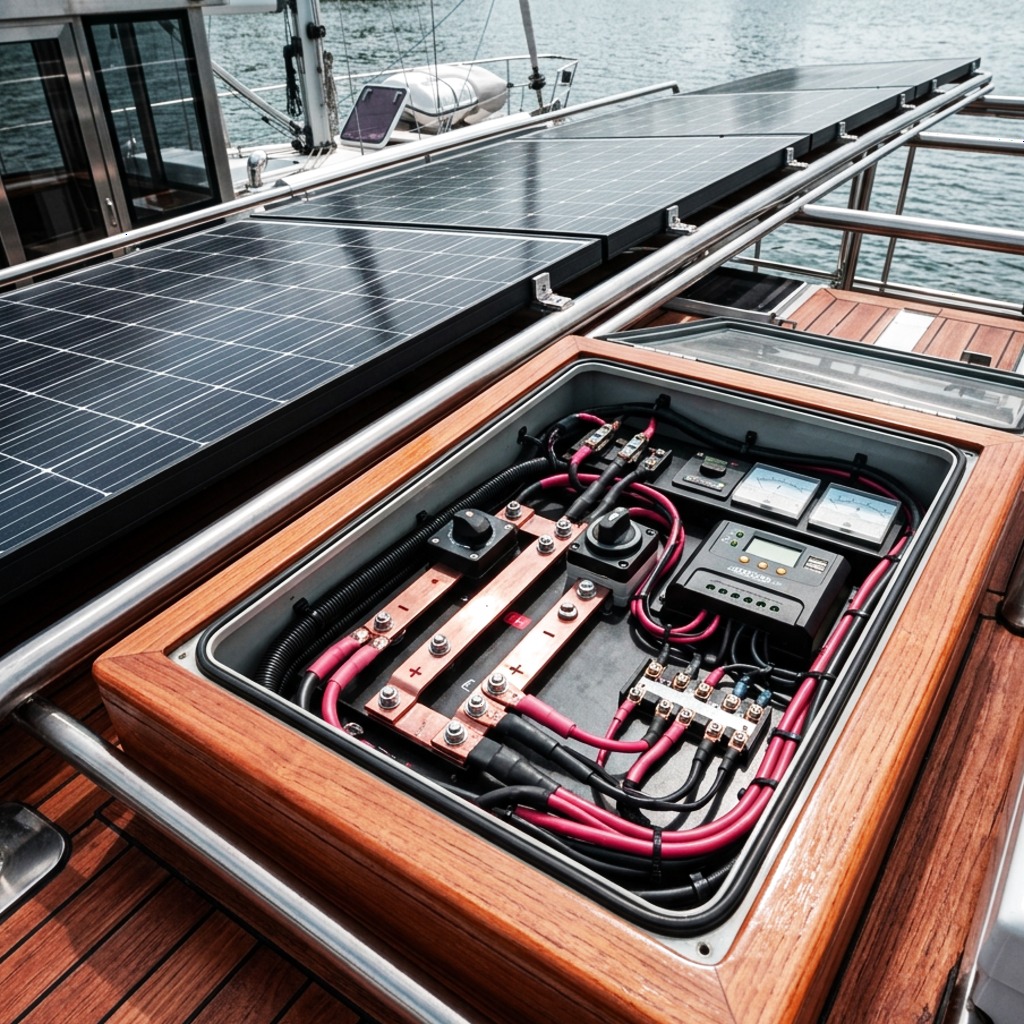
starlink · connectivity · tech
Starlink onboard — install, power, and reality
Starlink Maritime and Mini both work on UAE houseboats. The honest version: power draw, mounting, latency, what it costs to keep it on, and when it stops being worth the trouble.
For owners who anchor away from cellular coverage, or who cruise across the GCC's offshore stretches, Starlink has changed what's practical. Continuous high-bandwidth internet at sea is no longer something only superyachts have. It's also not free, not zero-effort, and not the right answer for every owner.
This is the working install and operational guide.
Hardware options
For UAE houseboat use, two products dominate:
Starlink Mini. Compact dish, 100W power draw, fits anywhere. Best for boats already equipped with solar/lithium banks where the modest power draw is easy. Roughly USD 600 unit cost.
Starlink Maritime (or Flat High Performance). Larger dish, 50-150W variable. More robust connection, better in heavy weather, certified for marine use. Roughly USD 2,500 unit cost.
For most UAE houseboats, the Mini handles the use case at a fraction of the cost. The Maritime version is overkill for typical Gulf cruising — it's designed for trans-ocean reliability that you don't need on a 90-minute hop to Saadiyat.
Service plans
Starlink's pricing has shifted several times. As of late 2025-2026:
- Roaming Unlimited: ~USD 165/month. Works globally; unlimited data. The default for most boats.
- Maritime plans: USD 250-1,000/month depending on speed and data tier.
- Local roaming (UAE only): Cheaper but limits coverage to specific country.
Most UAE houseboat owners running Mini hardware land on Roaming Unlimited as the practical balance.
Where to mount it
Starlink needs sky view — minimal obstructions overhead. On a houseboat, the practical options:
- Bridge deck pedestal mount. Highest position, clearest sky. Best technical performance.
- Radar arch. If the boat has one, this is the cleanest visual install.
- Bimini or hardtop. Acceptable for Mini; not ideal for the larger units.
- Cabin top with pedestal. Mid-tier; works but partial sky obstruction from the bridge can affect performance.
For most houseboats, a discreet bridge-deck pedestal is the right answer. Mount the antenna on a 30-50cm post that gives clear sky view in all directions.
Power considerations
Mini uses 50-100W typically. Drawn from 12V or 24V system depending on boat configuration.
For boats with substantial battery banks and solar:
- Solar offsets the daytime draw entirely
- Overnight, the bank handles 8-12 hours of Starlink without issue
- No real impact on the energy budget
For boats with smaller banks or AGM only:
- Starlink draws ~1.5 kWh per 24 hours of continuous use
- Meaningful relative to total bank capacity
- Owners often power-cycle Starlink — on during use, off when not actively needed
Latency and reliability
Starlink Mini latency in Gulf waters: typically 30-60ms in clear conditions. Comparable to land-based fibre. Video calls work cleanly; cloud apps respond normally; large file uploads handle without timeout.
Reliability degrades in:
- Heavy thunderstorms (rare in UAE summer; possible in winter)
- Sustained shamal winds with heavy spray
- Mountainous terrain blocking sky view (irrelevant offshore but worth noting on RAK trips near the Hajar mountains)
For 95% of UAE houseboat use, Starlink Mini delivers reliable broadband.
Speed expectations
Real-world download speeds in the Gulf range 80-200 Mbps depending on satellite congestion. Upload typically 10-30 Mbps. More than adequate for:
- HD video streaming
- Multiple simultaneous video calls
- Cloud-based work (file sync, real-time collaboration)
- Online gaming (latency is the limit, not bandwidth)
- Live-streaming if you're inclined
The bottleneck for most UAE owners isn't bandwidth — it's the cellular hotspot they were using before, which was 5-30 Mbps in marina waters and 0 Mbps offshore.
Common gotchas
A few items first-time installers find:
Cabling matters. The cable from antenna to router carries POE; sub-spec cable causes power and signal issues. Use the supplied cable or proper marine-rated equivalent.
Router placement matters. Inside the boat, away from the antenna's direct line. The supplied router has decent WiFi range but won't penetrate multiple steel bulkheads.
Multiple devices. Starlink Mini's WiFi handles 5-15 simultaneous devices comfortably. Larger groups need a separate marine-rated router with stronger WiFi.
Updates are forced. Starlink pushes firmware updates that occasionally cause brief outages. Plan around this for important calls.
Power cycling stress. Starlink doesn't love being toggled on and off frequently. Leave it on when in use; turn off completely when not. Avoid the middle ground.
When Starlink stops being worth it
Some honest counter-cases:
Marina-only use. UAE marinas have decent fixed broadband; many include WiFi in the berth fee. Starlink is overkill for boats that never leave a marina.
Casual use only. If you check email occasionally and don't work from the boat, your phone's hotspot probably suffices. Starlink's monthly cost is meaningful relative to the use.
Short-trip use. If you're on the boat 4 hours at a time on weekends only, Starlink rarely justifies its monthly fee.
For owners who:
- Anchor overnight regularly
- Cruise to Khor Al Adaid, Musandam, or other off-coverage areas
- Work from the boat
- Host paying charter customers who expect WiFi
Starlink earns its keep clearly.
A note on Starlink Mini's portability
The Mini's small form factor opens an interesting use case: it can be moved between boats, or between boat and other locations (e.g., a remote villa). For owners with multiple use cases, this flexibility is genuinely useful.
Just remember to bring the Mini back to the boat before the next trip.
Total cost of ownership
For Mini + Roaming Unlimited:
- Up-front: ~AED 2,500 (hardware) + AED 1,500-3,000 (install, mount, cabling)
- Monthly: ~AED 600
- Annual: ~AED 7,200
For most owners, this is comparable to one weekend of fuel. Easy maths if you actually use it.
Future-proofing
Starlink pricing and product lines have shifted multiple times. The current offering is settled enough to commit to; future direction (more vessel-specific products, lower-tier pricing) seems consistent with continued downward cost pressure.
Buying now is reasonable. Buying with the assumption that prices will keep falling is also reasonable. The decision isn't time-sensitive.
Have questions on anything in this piece? Send a note via /contact — we read every reply.
Written by
The 101Marine team
Field notes from the team that designs and builds 101Marine houseboats. We write when we have something practical to share.
More from Maintenance & Tech
See all →
Maintenance & Tech
Wood, gel coat, leather, fabric — what survives the Gulf, what doesn't
Material specification on a UAE-bound houseboat is a different problem than in temperate climates. Heat, UV, salt, and humidity reward some choices and punish others quickly.
Maintenance & Tech
The case for hybrid drives in houseboats — silent overnight, predictable economy
Hybrid diesel-electric installations on houseboats deliver silent overnight operation and meaningful fuel savings. The realistic version: where they win, where they don't.
Maintenance & Tech
The 30-minute pre-departure check that prevents 90% of trouble
A printable working checklist — engine room, deck, electrical, safety, weather. The owner habits that catch problems before they leave the dock.